Logotipo de la Hora del Código

Hour of Code

A global movement that includes more than 180 countries. 220 545 events registered in 2018, 1019 in Spain.

Hour of Code is a one-hour introduction to computer science, designed to show that anyone can learn to code and understand the basics of the field.


¿What is the Hour of Code?

Anyone can organize an “Hour of Code” at any time, but the main goal of this campaign is for tens of millions of students to try the “Hour of Code” on specific dates in celebration of Computer Science Education Week. Is it a specific hour? No. You can celebrate the “Hour of Code” at any time during that week. You can split “Hour of Code” into multiple sessions so your students can complete the “Hour of Code” tutorial. (And if you can’t do it during that week, do it the week before or the week after.)

¿WANT MORE DETAILS?

¿Why Computer Science?

All students should have the opportunity to learn computer science. It helps foster problem-solving skills, logic, and creativity. Introducing students to computer science at an early age will equip them with essential knowledge for the 21st century—knowledge that is fundamental regardless of their future career paths. See more statistics at Code.org.

¿How can I participate in the Hour of Code?

Start planning here by checking out our guide on how to do it. You can organize a Hour of Code event at your elementary or high school, or in your community—for example, at an after-school workshop, a nonprofit organization, or your workplace. Just give it a try when December 3 rolls around.

¿Who is behind the Hour of Code?

Hour of Code is organized by Code.org, a public nonprofit organization (501(c)(3)) dedicated to promoting participation in computer science in schools and colleges, with a special focus on increasing the number of women and students from underrepresented groups who learn to code. An unprecedented coalition of partners has also come together to support Hour of Code—including Microsoft, Apple, Amazon, Boys & Girls Clubs of America, and the College Board.

Logotipo de la Hora del Código
1

I don't know anything about programming. Can I still organize an event?

Of course. Hour of Code activities are self-guided. All you have to do is check out our current tutorials, select the one you want, and choose a time—we'll take care of the rest. We have options for every age and experience level, from kindergarten and up. Start planning your event by reading our guide.

What devices should I use for my students?

Code.org tutorials work on all devices and browsers. You can find more information about the technical requirements for Code.org tutorials here. The technical requirements for non-Code.org tutorials can be found in the specific tutorial description. Don't forget that we also offer offline activities if your school can't host the tutorials!

Do I need a computer for each participant?

No. We have Hour of Code tutorials that work on PCs, cell phones, tablets, and some that don’t even require a computer! You can join in from wherever you are, using whatever you have. Here are some options:

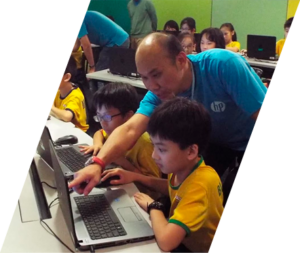
  • Work in pairs. Research shows that students learn best when programming in pairs, sharing a computer and working together. Encourage your students to work in pairs.
  • A projector. If you have a projector and a computer connected to the Internet, the whole group can participate in an Hour of Code together. Watch parts of the videos and take turns solving and answering the questions.
  • Go offline. We offer tutorials that don’t require a computer.

Do students need to log in with their own accounts?

No. No registration or login is required for students to try Hour of Code. Most follow-up courses require students to create an account to save their progress. Registering for Hour of Code does not automatically create an account in Studio Code. If you want to create accounts for your students, please follow these instructions.

Marca de agua del logotipo de HP

I'm in Spain. How can I participate internationally?

Anyone can organize a Hour of Code event, anywhere in the world. Last year, students from all over the world took part in an Hour of Code. Find more information here.

How can I create a Hour of Code tutorial?

If you're interested in submitting tutorials, please review our guidelines and instructions. We want to offer a variety of engaging options, but our main goal is to optimize the experience for students and teachers who are just getting started in computer science.

Where can I print certificates for my students?

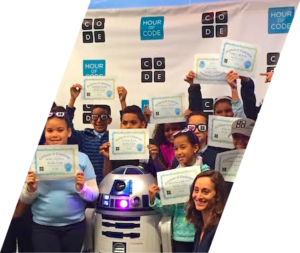
Go to our certificates page, where you can print certificates for your entire class in advance.

What activities can I do with middle school students?

Our Star Wars and Minecraft tutorials are great for middle school students, especially the JavaScript version of Star Wars and the free-play level in both tutorials. Alternatively, we recommend trying one of the beginner tutorials at code.org/learn to get started, such as the Angry Birds tutorial or the one featuring Anna and Elsa. A middle school student will be able to complete it in 30 minutes and can then try a more advanced JavaScript tutorial, such as those on Khan Academy or CodeHS.

I teach Scratch for Hour of Code, but what if my students use iPads instead of laptops?

Scratch doesn't work on tablets. If your students are young, they can use the ScratchJR app for iPad (for children who are just learning to read). If you look through the tutorials at code.org/learn, you can find others that work on iPads—from Code.org, Tynker, Lightbot, or CodeSpark.

How are Hour of Code sessions counted?

Tracking the Hour of Code is not an exact measure of usage. We do not accurately count students’ unique identifiers when tracking participation in the Hour of Code, primarily because we do not require students to log in or register. As a result, we cannot count the number of participants working at the same time. Learn all the details here.

Why can't I see my location on the map?

We're sorry you can't see your event on the Hour of Code map. Because tens of thousands of organizers sign up, the map aggregates the data and displays a single marker for multiple events. If you click on the number at the top of the map, you’ll be taken to a list of all events by state, where you’ll find yours listed. Also, because thousands of people register for Hour of Code, the map and event list usually take 48 hours to update. Check back in a few days!

¿How much can be learnt in an hour?

The goal of Hour of Code is not to teach anyone to become a computer science expert in one hour. One hour is simply meant to show that computer science is fun and creative, and that it is accessible to all ages and all students, regardless of their background. The measure of this campaign’s success is not how much computer science students learn—success is reflected in broad participation across genders, ethnic groups, and socioeconomic backgrounds, as well as in increased enrollment and participation in computer science courses at all levels. Millions of participating teachers and students have decided to go beyond one hour—to learn for a day, a week, or longer—and many students have decided to enroll in an entire course (or even at the university level) as a result.

In addition to the students, another “student” is the educator, who gains the confidence after just one hour to teach computer science even though they do not have a college degree as a computer scientist. Tens of thousands of teachers decide to continue in computer science by taking online continuing education courses, attending professional development sessions, or both. And this applies to school administrators as well, who realize that computer science is something their students want and their teachers are capable of delivering.

Above all, what all participants can learn in an hour is how we can do this.

Logotipo de la Hora del Código

How can you keep learning after Hour of Code?

Anyone can host an Hour of Code event at any time. The tutorials are available year-round. You can expect all of our tutorials and curricula to be available on our website indefinitely. Please visit our resources page for event guidelines and other materials to help make your Hour of Code event a success.

TOP